 HyperMindZ Team
If you’ve been anywhere near AI infrastructure or agentic systems lately, you’ve probably heard people talk about MCP — the Model Context Protocol.
Think of MCP as a common language that lets AI agents and tools talk to each other safely and consistently — kind of like how HTTP made the web interoperable.
So far, so good.
But until now, MCP had one big limitation: it assumed that everything happens instantly.
And if you’ve ever worked in advertising or marketing tech, you know nothing happens instantly.
Real Life Isn’t Instant
Most marketing operations take time — sometimes hours, sometimes days.
- You launch a campaign, but data ingestion takes hours.
- You run a lift study, but results come back next week.
- You request brand approval, but legal takes two days.
- You start creative rendering, and the videos are still transcoding tomorrow morning.
Every one of these steps is a long-running task — something that starts now, but finishes later, often after some human input or system dependency.
Until now, AI systems using MCP didn’t have a standard way to handle that.
They’d start a task and… well, either hang or disappear.
That’s exactly the problem SEP-1391 solves.
SEP-1391: Giving MCP “Patience”
SEP-1391 is a new proposal that adds long-running job support to MCP.
Here’s what that means in plain language:
Instead of expecting every job to finish right away, a tool can now say:
“I’ve got your request. It’s in progress. Here’s a token — check back later.”
That token acts like a tracking number for your AI task.
You can ask:
- What’s the status? (
submitted,working,input_required,completed) - Does it need human input before continuing?
- How long should I keep the result available (
keepAlive)?
It’s exactly how real-world systems operate — finally expressed in the AI protocol layer.
What This Means for AdTech and Marketing
Let’s connect the dots.
The advertising ecosystem is a patchwork of asynchronous systems:
- DSPs optimizing bids
- SSPs clearing auctions
- Data clean rooms joining IDs
- Attribution engines back-filling conversions
- Compliance layers validating evidence bundles
Every one of these workflows involves waiting, resuming, or approving.
And every vendor currently handles it differently.
SEP-1391 gives all of them a shared language for asynchronous coordination.
Imagine:
- A clean room job can mark itself as
input_requiredwhen a legal review is pending. - A measurement system can expose a
workingstatus while calculating lift. - A DSP optimization agent can check
completedbefore moving to the next stage.
No custom integrations. No silent timeouts. No black-box jobs.
Just clear, auditable async handshakes between systems.
Compliance and Human-in-the-Loop Moments
One of the most powerful parts of SEP-1391 is that new middle state:
input_required.
That’s the protocol’s way of saying:
“Pause here — a human needs to approve this before we continue.”
In marketing, that’s everything:
- Approving a sensitive audience segment
- Reviewing an AI-generated creative
- Verifying a spend allocation
- Signing off on an attribution model
And because MCP tracks it all through one token, the entire chain — from action to approval to outcome — becomes traceable and auditable.
That’s a big step toward compliance-ready AI operations.
State Management: Who Remembers What
When you say “come back later,” someone has to remember where you left off.
That’s called state management.
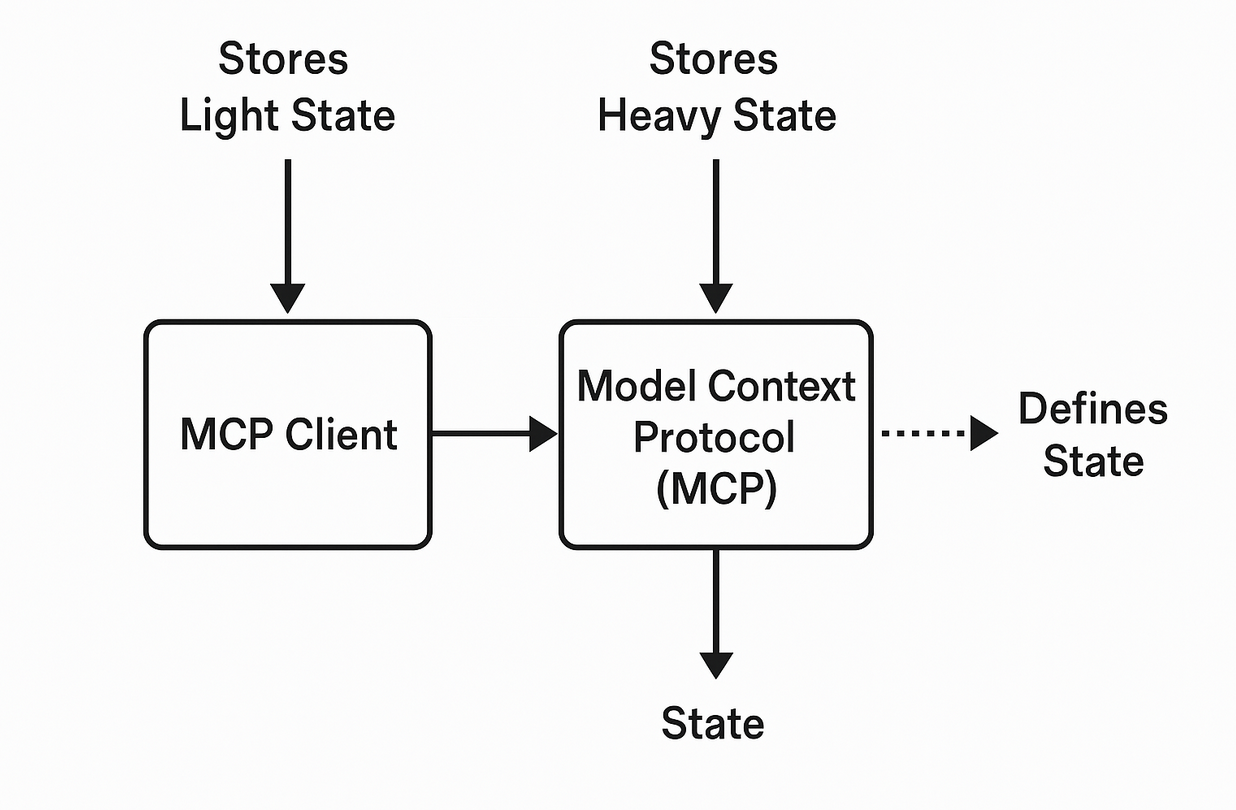
The client (like an AI agent) keeps light state — job IDs, poll timers.
The tool (like a clean room or analytics engine) keeps heavy state — actual job progress, artifacts, and results.
The MCP protocol defines how both sides talk about that state.
That division of labor is what makes SEP-1391 scalable.
Each system only holds what it truly owns — and everyone speaks a shared language of status and results.
A More Interoperable Future
Let’s be honest: AdTech is famous for fragmentation.
Every system uses its own queue, its own job schema, its own status API.
SEP-1391 doesn’t eliminate that complexity overnight.
But it gives us a shared foundation — a way for every vendor, data partner, or AI agent to coordinate asynchronously without reinventing the wheel.
In short:
- MCP made AI systems interoperable.
- SEP-1391 makes them reliable.
The Bottom Line
If you build or operate in AdTech, SEP-1391 might sound like a small technical tweak — but it’s actually a massive step forward.
It means:
- Jobs won’t vanish when they take time
- Approvals fit naturally into automated flows
- Results can be audited after the fact
- Humans and agents can finally collaborate smoothly
The modern advertising stack is asynchronous by design.
Now, the AI layer finally speaks that language too.
In One Line
SEP-1391 gives AI agents the patience, memory, and accountability real AdTech has always needed.