 HyperMindZ Team
If you’ve been following the Model Context Protocol (MCP) — the open standard that lets AI agents and tools talk to each other — you’ve probably heard whispers about a new proposal called SEP-1391.
So what is it, in plain English?
Think of SEP-1391 as a “patience upgrade” for MCP.
Until now, MCP assumed that when an agent calls a tool, the job finishes instantly — like asking your calculator for 2+2.
But in the real world, AI doesn’t just answer questions; it runs tasks that take time — like generating reports, training models, or waiting for human approval.
SEP-1391 introduces a simple idea:
You can start a job now, get a tracking ID, and check back later when it’s done.
That small change makes MCP dramatically more useful for real enterprise workloads — especially in industries like advertising, marketing, and data where asynchronous jobs are the norm.
What SEP-1391 Adds
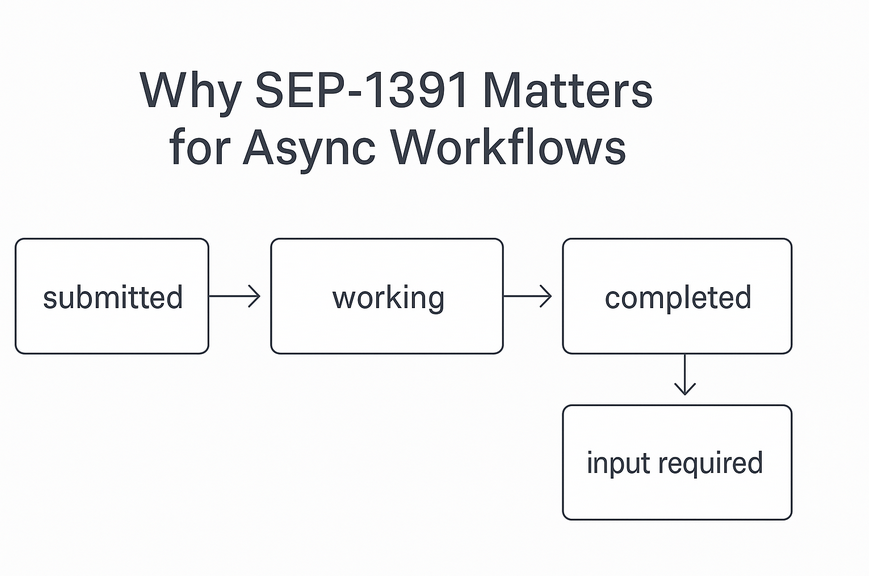
In short: it gives MCP a way to handle long-running, stateful jobs gracefully.
- Start a job → Get a token back immediately
- Track progress with tools/async/status
- Fetch results later via tools/async/result
It’s like getting a FedEx tracking number for your AI task — you know where it stands without waiting on the line.
New concepts include:
- Async mode:
invocationMode: "async" - Job states:
submitted,working,input_required,completed,failed,canceled - Polling hints: how often to check and how long results are stored (
keepAlive)
Why It Matters (Especially for AdTech + MarTech)
Almost every serious marketing workflow runs long:
- Data ingestion & clean-room joins — hours of processing
- Lift or incrementality studies — days or weeks of data collection
- Creative QA & variant generation — human approvals mid-flow
- Budget pacing or optimization — algorithms iterating in the background
- Compliance or audit bundles — async reports that must stay retrievable
These are not instant operations. They need checkpoints, human input, and proof of completion.
That’s exactly what SEP-1391 brings to MCP.
The New Lifecycle
Every async task can now move through these states:
submitted → working → input_required → completed → failed → canceled
That middle one — input_required — is especially powerful.
It lets a human pause, approve, or modify a job without breaking it.
The Bigger Shift
This evolution turns MCP from a simple “call-and-response” system into a true orchestration layer — one that understands time, state, and human checkpoints.
For teams building agent-based automation in AdTech, MarTech, or enterprise AI, that means:
- Jobs can span hours or days
- Humans can review or intervene mid-run
- Results stay auditable and retrievable
In other words, MCP just learned how to operate in the real world.
In One Line
If SEP-0001 made MCP interoperable,
SEP-1391 makes it durable.
Agents can now wait, resume, and prove they’ve done the work.